Platform
Every layer, one system
Most reliability stacks are a science project: sensors from one vendor, an APM from another, and a CMMS that never hears about any of it. KNOCE is one platform from the I/O terminal to the work order — the seeing half of an APM and the doing half of a CMMS, in one system with one database.
CMMS + APM, converged
The best of your CMMS. The best of an APM. One system.
Your CMMS executes — but can't see
Work orders, PM schedules, parts, labor, history: the discipline of maintenance. But it learns about equipment condition when a human types it in — so PMs run by the calendar, too early for healthy machines and too late for failing ones.
An APM sees — but can't execute
Baselines, anomaly detection, health scores: it knows the bearing is degrading. But its output is an alert — an email, a dashboard flag, a CSV. Detection nobody turns into work is just better-informed downtime.
The gap between them is where the failure happens
The APM detects on Tuesday. The alert sits in an inbox. Someone re-types it into the CMMS Thursday. The work order appears Friday. The bearing failed Wednesday night. Every arrow between two systems is latency, and every re-type loses the evidence — which is why the integration project meant to fix it is where budgets go to die.
In KNOCE, the detection and the execution share one database because they are one product: finding → decision → work order → history — with the evidence attached the whole way. And if you already run a CMMS you love, keep it: KNOCE creates the work; your system executes it.
01 · Connect
Get data flowing from anything on the plant floor
The KNO1-PLC acquires signals directly through 76 on-board I/O channels, or reads from the control systems you already run — no rip-and-replace, no proprietary sensor lock-in.
- OPC-UA and Modbus Pilot and CAN connections to the PLCs, mobile controllers, engine ECMs, genset controllers, and drives already on the equipment — Allen-Bradley, Siemens, Schneider, CODESYS, Parker, Danfoss, Caterpillar, Woodward, ABB, and more
- Direct sensor acquisition: 4-20 mA, 0-10 V, resistance, frequency, and microvolt-resolution inputs
- MQTT to the cloud as JSON with named tags — the site pipeline asks each device what it can stream, time-syncs up to 30 sources, and publishes them as one feed
- Store-and-forward buffering: connectivity drops never lose data
Why named tags matter
Point the site pipeline at a device by IP address and it discovers what the device can stream, then publishes every value under the name the installer gave it. Tags arrive in the platform already named and typed, organized facility → asset → tag — so a new site comes online in hours, not integration-weeks. It's the difference between plumbing and a nervous system.
What KNOCE connects to
Driver status: KNO1-family devices (native stream) Available · OPC-UA and Modbus drivers Pilot · CAN J1939, EtherNet/IP, PROFINET — confirmed per deployment.
Organized the way a spread or a plant is actually built — by layer, not by logo.
| PLCs & panel controllers | Allen-Bradley ControlLogix / CompactLogix · Siemens S7-1500 / S7-1200 · CODESYS-based controllers · Schneider Modicon · Omron · Mitsubishi · Beckhoff · process plants: Siemens PCS 7 / WinCC over OPC-UA, Modbus TCP, EtherNet/IP*, PROFINET* |
| Mobile machine controllers | Parker IQAN · Danfoss PLUS+1 · HED CANect — the controllers on pump units, blenders, and hydration units over CAN / J1939*, Modbus |
| Engines, turbines & gensets | Caterpillar, Cummins, and MTU / Rolls-Royce engine ECMs · Woodward, ComAp, Deep Sea Electronics, and Basler genset controllers · turbine OEM control systems over CAN J1939*, Modbus RTU / TCP, OPC-UA |
| Drives & electrical (e-frac) | ABB, Siemens, Rockwell PowerFlex, and TMEIC variable-frequency drives · switchgear and power meters over Modbus TCP, EtherNet/IP* |
| SCADA, historians & data | Ignition (Inductive Automation) · AVEVA / Wonderware · AVEVA PI (OSIsoft) · existing MQTT brokers over OPC-UA, MQTT |
| Direct sensors | 76 on-board I/O channels: 4-20 mA, 0-10 V, resistance, frequency, microvolt inputs — no intermediate hardware |
All product and company names are trademarks of their respective owners. References describe protocol connectivity only and do not imply partnership, certification, or endorsement. Items marked * are confirmed per deployment.
02 · See
Live visibility that operators actually use
Fleet overview
Every asset across every site with a live health score, status, trend sparkline, and gateway connectivity. Data is organized facility → asset → tag from the site broker up, so a control room can toggle between customers and sites in one click and land on the alarm that matters.
Alarm management
Built to ISA-18.2 practice: priorities, acknowledge with attribution, shelving, and state-based suppression — plus source attribution, so you always know whether a threshold, an analyst, or the AI raised it.
24/7 operations view
A purpose-built monitoring-center screen: priority attention queue, unacknowledged alarms, and the live AI detection feed — for your team or a service provider's NOC.
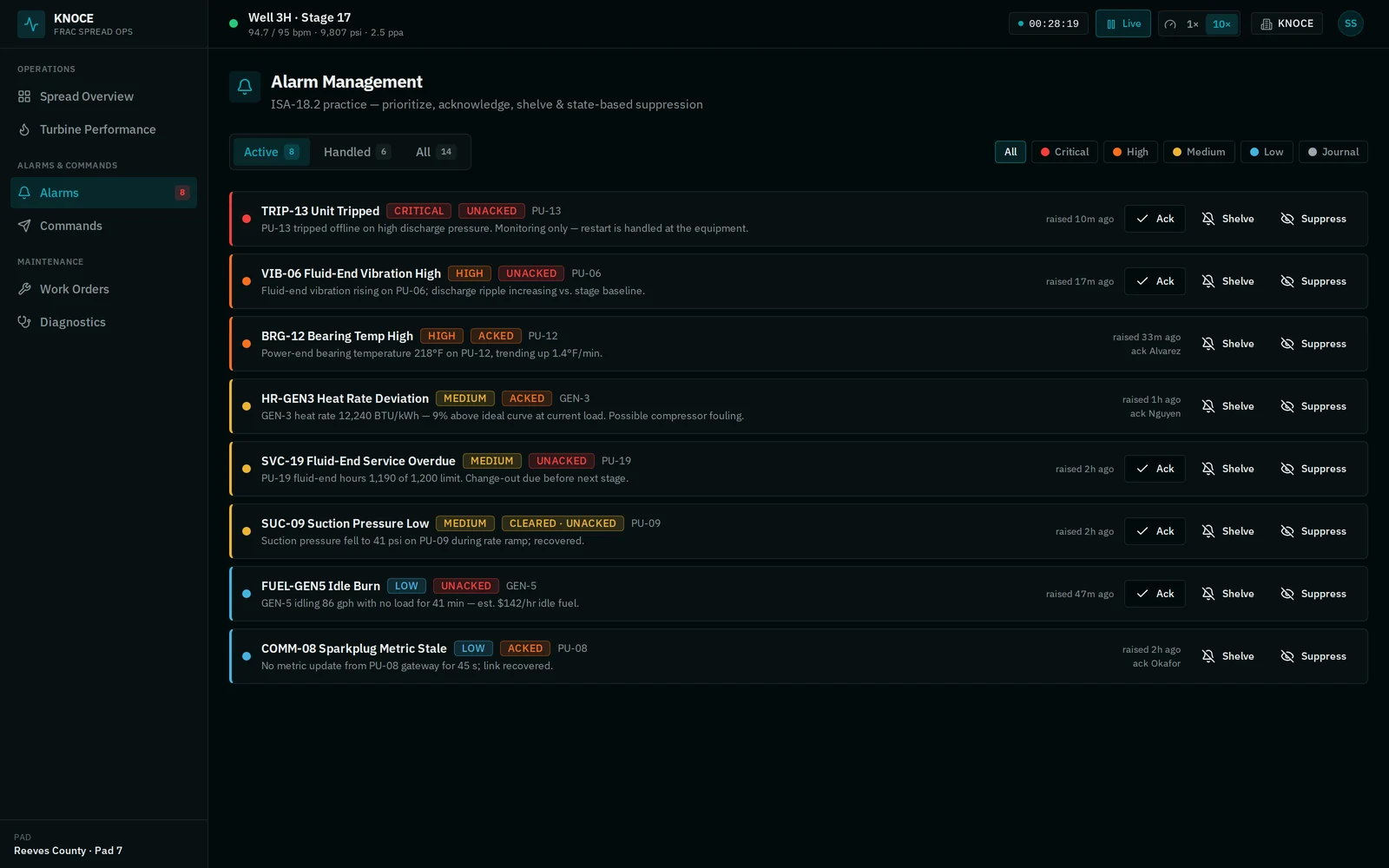
Alarm management in the KNOCE platform — ISA-18.2 priorities and lifecycle, with source attribution on every alarm.
03 · Predict
AI that finds failures while they're still cheap
- Baseline learning. Pilot The platform learns each asset's normal operating envelope from its own history — every machine is judged against itself, not a generic template.
- Anomaly detection with confidence. Pilot Every detection carries a confidence score and severity tier, so your team knows what to act on now and what to watch.
- Failure-mode diagnostics in plain language. Pilot Not "sensor 14 deviation" — "vibration pattern consistent with outer-race bearing wear," with the evidence attached.
- Remaining useful life. Roadmap Degradation trends become time estimates, so replacements land in planned windows instead of emergency callouts.
Honest by design
AI predictions are only as good as the data behind them. KNOCE models sharpen with every operating hour on your equipment — and every detection shows its confidence and its evidence, so your engineers can verify the reasoning instead of trusting a black box.
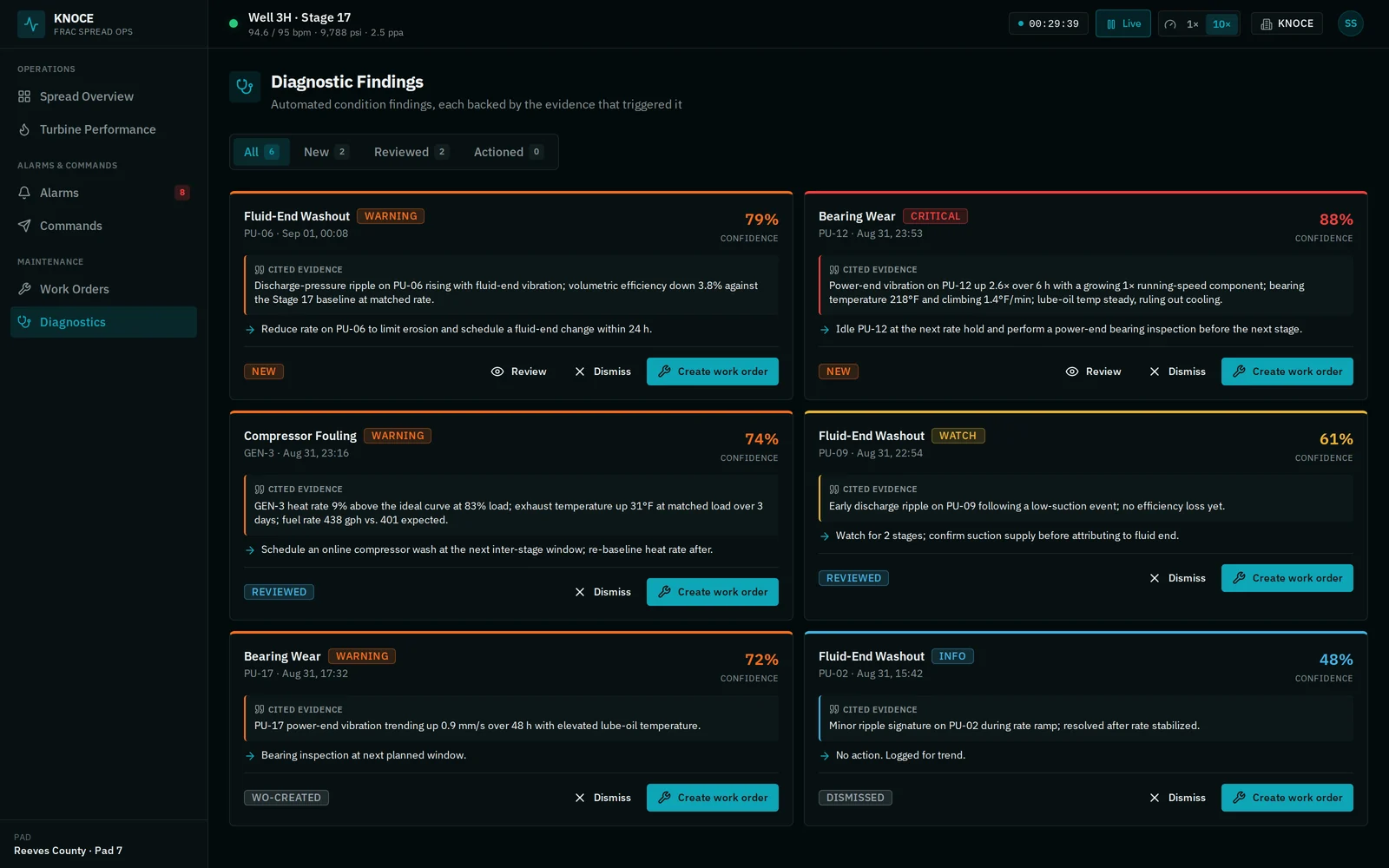
Diagnostic findings — every detection shows its severity, confidence, and the evidence behind it.
Others monitor machines. KNOCE connects machine health to operations.
sensor → machine state → operating context → AI finding → operator decision → maintenance action → equipment history
A vibration reading at idle is not the same reading at 80% pumping load. Operating context is what turns a detection into a decision — and it is the part a standalone sensor platform doesn't have. Every KNOCE finding carries the operating state it was seen in, the decision the operator made, and the work that followed.
04 · Act
Predictions that become work, automatically
Auto-generated work orders
A confirmed detection creates a work order with the failure mode, recommended action, suggested parts, and labor estimate — pre-filled, not blank. Run-time counters raise routine orders the same way: when fluid-end hours cross the service limit, the order writes itself.
Your maintenance system executes it
KNOCE creates the work; your CMMS or EAM runs it. Native KNOCE work management is included, with Jira as the first available integration and two-way integrations to SAP PM, IBM Maximo, ServiceNow, MaintainX, Fiix, and UpKeep on the integration roadmap — so the order lands where your technicians already live.
Full equipment history
Every alarm, detection, command, and completed job accumulates per asset — with a technician completion view built for the field, so the record gets written where the work happens.
Supervisory command flow
Operational requests move through request → validate → acknowledge → execute → audit — every step timestamped and attributed. Remote operations with a paper trail, and a hard boundary: protective and safety functions always remain with the certified hardware layer.
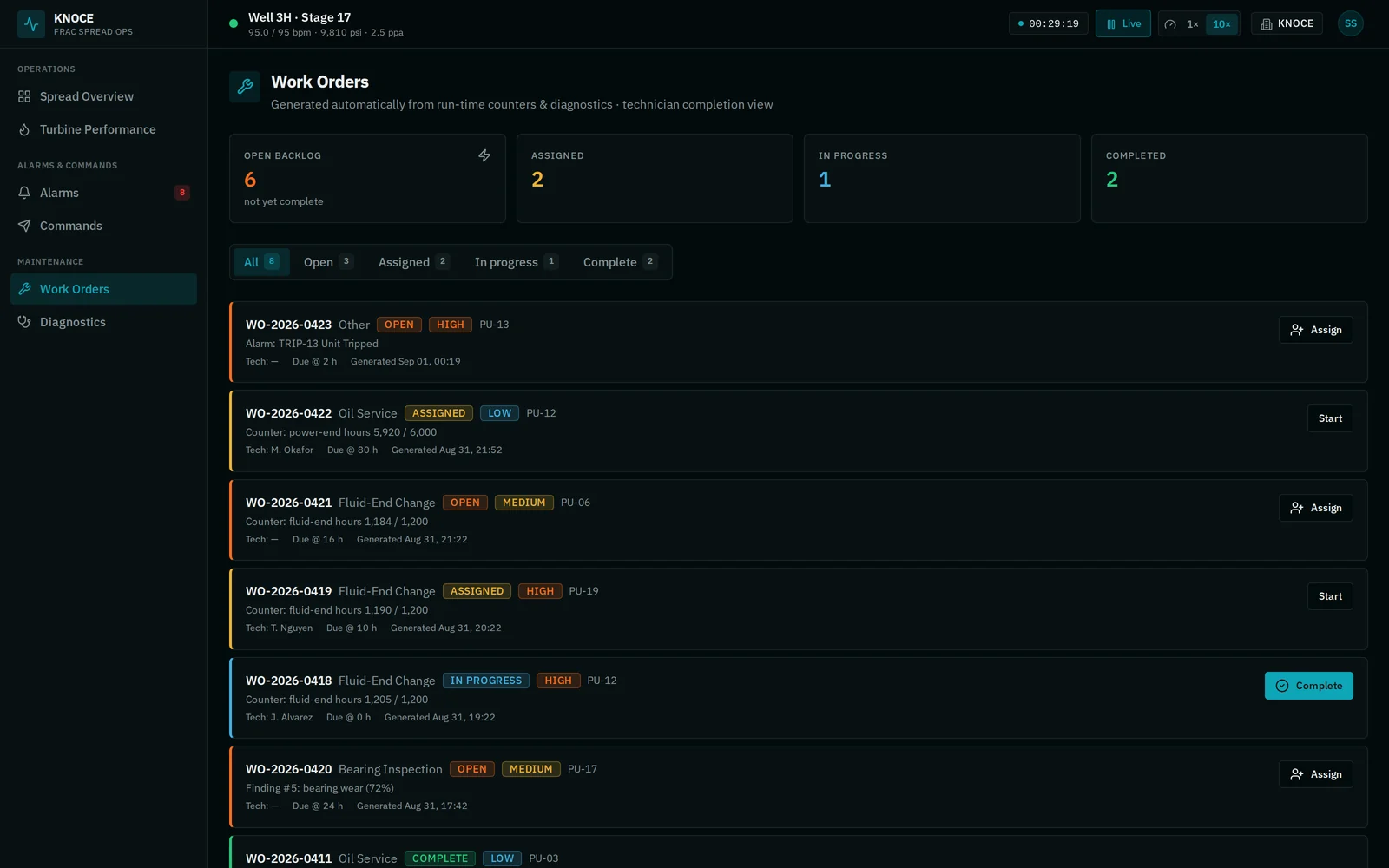
Work orders — raised automatically from run-time counters and confirmed findings, tracked open to complete.
Edge AI
The intelligence is built to live on the device Roadmap
Most platforms ship raw data to the cloud and think there. KNOCE is designed to think at the machine — on acceleration built into the controller — and uses the cloud for what the cloud is good at: fleet learning, history, and heavy analysis.
- Store-and-forward keeps telemetry intact through connectivity loss Available — 50 ms data logged locally, log files forwarded hourly, the live stream rate configurable, and local storage expandable for long outages. On-device inference that keeps detecting with zero connectivity — remote pads, substations, pump stations — is where the architecture is headed Roadmap
- Raw operational data can stay on-site; only detections and summaries need to leave — a real answer for data-sovereignty policies
- MCP agent interface Preview: MCP-compatible AI agents can query I/O, diagnostics, alarms, and setpoints directly from the controller
Security posture
TPM 2.0 hardware root of trust and an IEC 62443-ready design. Read-only by design: in gateway mode KNOCE does not issue control writes to the PLC or alter control logic, and deployment is designed around segmented, least-privilege, outbound-only connectivity.