Edge intelligence for industrial equipment

Know your machines are healthy.
Know before they fail.

KNOCE combines rugged control hardware, on-device AI, and a cloud monitoring platform to catch equipment failures before they stop production — proven on frac pads, built for any plant.

Pump 3 · Bearing vibration · mm/s LIVE
⬡ Anomaly detected — bearing wear · RUL 120 hrs — work order created
76
Configurable I/O channels
IP69
Washdown-rated enclosure
-40–185°F
Operating temperature
~15 W
Typical power draw
24/7
Monitoring-ready platform

Proven where it's hardest

Born on the frac pad

We didn't build KNOCE in a lab. We built it for hydraulic fracturing — remote sites, brutal duty cycles, no fiber, no second chances. If it survives a frac pad, your plant is easy.

The platform

From sensor to work order, one system

01

Connect

Data from any equipment — direct I/O or beside your existing Siemens, Allen-Bradley, and CODESYS systems.

02

See

Live dashboards, fleet health scores, and severity-tiered alarms across every site.

03

Predict

AI anomaly detection with failure modes, confidence scores, and remaining-useful-life estimates.

04

Act

Detections become work orders automatically — parts, labor, and telemetry attached.

KNO1-PLC hardware

One rugged box. Two ways to deploy it.

Run it as the full controller — or as a smart gateway beside the PLCs you already own, reading data over OPC-UA and touching nothing.

For integrators & service providers

Run your monitoring service on KNOCE

License the platform, lease the hardware, and launch a recurring-revenue monitoring business under your own brand.

Frac Operations Platform

The whole spread.
One screen.

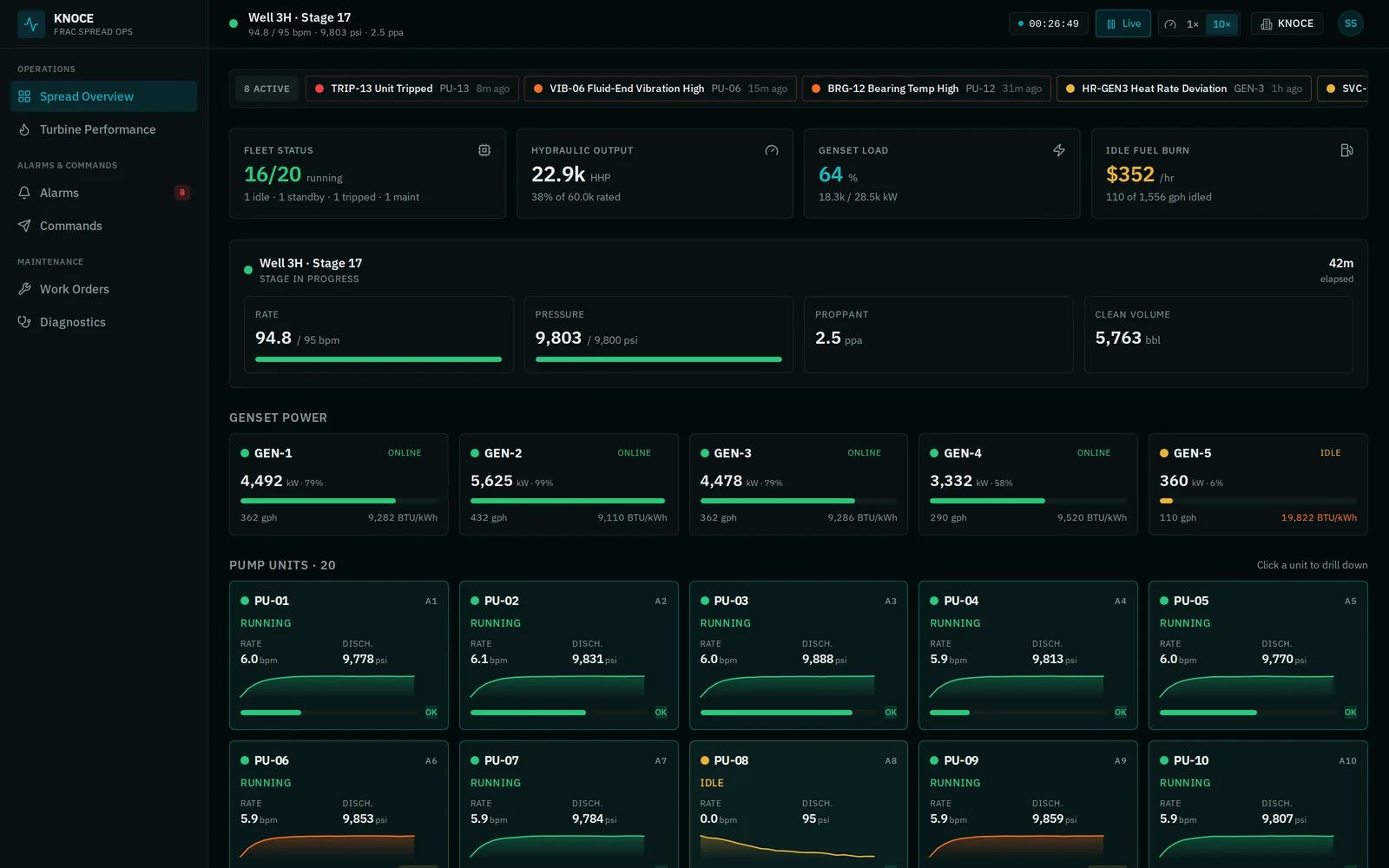
A frac supervisor or remote operations center has never had a single credible screen showing the entire spread — every pump unit, every genset, and the stage in progress. The OEM's HMI shows one unit at a time; everything else lives in spreadsheets and judgment. KNOCE Frac Operations is that screen.

The four numbers on top of every shift

18/20
Fleet status — running · idle · standby · tripped
54.2K HHP
Hydraulic output vs. rated
78%
Genset load — kW against capacity
$142/hr
Idle fuel burn — visible for the first time

Representative values. Idle fuel burn deserves the last word: turbine fuel consumed between stages has always been invisible on every other system. KNOCE prices it live, per hour, so the cost of an idle decision is on the screen while the decision is being made.

See the spread

Live operations, from fleet to fluid end

Spread overview

A tile per pump unit — status, health, and live vitals — with the genset power strip, the current stage panel, and an alarm ribbon across the top. The screen a supervisor keeps open all shift.

Unit drill-down

Any unit, one click deep: discharge and suction pressure, rate, RPM, power-end and fluid-end vibration, bearing and lube-oil temperature — live and trended — beside run-time counters and service-interval status.

Turbine performance

Per-genset load curve with droop characterization, heat rate against the ideal curve, fuel rate, and exhaust temperature — the difference between a healthy turbine and a fouling one, visible on one chart.

Stage tracking

The live stage panel holds targets against actuals — rate, pressure, proppant, fluid volume, elapsed time — so the spread view and the stage plan are finally the same screen.

Run it with discipline

Alarms and commands your auditor would approve of

Alarm management, to ISA-18.2 practice

Not a scrolling wall of red. Alarms carry priority (critical, high, medium, low, journal) and a full lifecycle — active, acknowledged, cleared — with shelving and state-based suppression, so nuisance alarms stop training your operators to ignore the board.

  • Acknowledge with attribution — who, when, every time
  • Shelve with a timer instead of silencing forever
  • State-based suppression kills alarm floods at the source

Supervisory command flow

Operational requests — reduce rate, idle a unit, bring one online, hold — move through a five-step flow, every step timestamped and attributed:

Requested Validated Acknowledged Executed Audited

Remote operations with a paper trail — the record of who asked, who approved, and what happened exists before anyone asks for it.

Maintain on evidence

Findings with receipts. Work orders that write themselves.

Diagnostic findings, evidence cited

Fluid-end washout. Power-end bearing wear. Compressor fouling. Each finding arrives with a severity, a confidence percentage, and the trend evidence that triggered it — so an engineer can verify the reasoning, not trust a black box. One click turns a confirmed finding into the right work order: a washout becomes a fluid-end change, bearing wear becomes a bearing inspection.

Work orders from run-time, not memory

Fluid-end hours, power-end hours, and total barrels pumped accumulate live on every unit — and when a counter crosses its service limit, the work order raises itself. Orders flow open → assigned → in progress → complete, with a technician completion view built for gloved hands, and every completed job feeding the unit's permanent history.

Where the safety line sits

KNOCE Frac Operations is a monitoring and supervisory-request layer. All protective functions — emergency shutdown, overpressure protection, interlocks — remain with the certified hardware layer, fully independent of this software. That boundary is deliberate, it's how responsible operators expect the stack to be built, and we put it in writing.

Under the hood

The signals it speaks natively

Data arrives over MQTT Sparkplug B, matching pad broker topology — from KNO1-PLC gateways or existing acquisition.

discharge_psi · suction_psi · rate_bpm · rpm · power_end_vib · fluid_end_vib · bearing_temp · lube_oil_temp · hhp_used · fluid_end_hours · power_end_hours · total_pumped_bbl · load_kw · load_pct · heat_rate_btu_kwh · fuel_rate_gph · exhaust_temp · stage_targets · proppant

Platform

Every layer, one system

Most monitoring stacks are a science project: sensors from one vendor, historian from another, analytics from a third, and a CMMS that never hears about any of it. KNOCE is one platform from the I/O terminal to the work order.

01 · Connect

Get data flowing from anything on the plant floor

The KNO1-PLC acquires signals directly through 76 on-board I/O channels, or reads from the control systems you already run — no rip-and-replace, no proprietary sensor lock-in.

  • OPC-UA and Modbus connections to Siemens PCS 7, WinCC, Allen-Bradley, and CODESYS systems
  • Direct sensor acquisition: 4-20 mA, 0-10 V, resistance, frequency, and microvolt-resolution inputs
  • MQTT Sparkplug B to the cloud — structured telemetry with auto-discovery and birth/death state
  • Store-and-forward buffering: connectivity drops never lose data

Why Sparkplug B matters

Plain MQTT moves bytes; Sparkplug B moves meaning. Every tag arrives in the platform already named, typed, and stateful — so a new site comes online in hours, not integration-weeks. It's the difference between plumbing and a nervous system.

02 · See

Live visibility that operators actually use

Fleet overview

Every asset across every site with a live health score, status, trend sparkline, and gateway connectivity — filterable by site, customer, or condition.

Alarm management

Built to ISA-18.2 practice: priorities, acknowledge with attribution, shelving, and state-based suppression — plus source attribution, so you always know whether a threshold, the cloud AI, or the on-device AI raised it.

24/7 operations view

A purpose-built monitoring-center screen: priority attention queue, unacknowledged alarms, and the live AI detection feed — for your team or a service provider's NOC.

03 · Predict

AI that finds failures while they're still cheap

  • Baseline learning. The platform learns each asset's normal operating envelope from its own history — every machine is judged against itself, not a generic template.
  • Anomaly detection with confidence. Every detection carries a confidence score and severity tier, so your team knows what to act on now and what to watch.
  • Failure-mode diagnostics in plain language. Not "sensor 14 deviation" — "vibration pattern consistent with outer-race bearing wear," with the evidence attached.
  • Remaining useful life. Degradation trends become time estimates, so replacements land in planned windows instead of emergency callouts.

Honest by design

AI predictions are only as good as the data behind them. KNOCE models sharpen with every operating hour on your equipment — and every detection shows its confidence and its evidence, so your engineers can verify the reasoning instead of trusting a black box.

04 · Act

Predictions that become work, automatically

Auto-generated work orders

A confirmed detection creates a work order with the failure mode, recommended action, suggested parts, and labor estimate — pre-filled, not blank. Run-time counters raise routine orders the same way: when fluid-end hours cross the service limit, the order writes itself.

Jira-native

Work orders live in Jira with equipment-level organization and two-way sync. Teams already on Jira change nothing; teams without a CMMS get one that works on day one.

Full equipment history

Every alarm, detection, command, and completed job accumulates per asset — with a technician completion view built for the field, so the record gets written where the work happens.

Supervisory command flow

Operational requests move through request → validate → acknowledge → execute → audit — every step timestamped and attributed. Remote operations with a paper trail, and a hard boundary: protective and safety functions always remain with the certified hardware layer.

Edge AI

The intelligence lives on the device

Most platforms ship raw data to the cloud and think there. KNOCE thinks at the machine — on acceleration built into the controller — and uses the cloud for what the cloud is good at: fleet learning, history, and heavy analysis.

  • On-device anomaly detection keeps working with zero connectivity — remote pads, substations, and pump stations stay protected
  • Raw operational data can stay on-site; only detections and summaries need to leave — a real answer for data-sovereignty policies
  • Built-in MCP agent interface: AI agents like Claude can query I/O, diagnostics, alarms, and setpoints directly — ask about bearing temps on unit 3 and the machine answers

Security posture

TPM 2.0 hardware root of trust and an IEC 62443-ready design. In gateway mode, integration is read-only — your control logic is never touched, and the attack surface a new device usually adds simply isn't there.

KNO1-PLC

The controller with a brain

One sealed industrial controller that replaces the PLC, the I/O rack, and the cabinet — or drops in beside your existing systems as a smart gateway. Adaptive compute, real-time control, and AI acceleration in a single 12-inch box.

Two deployment modes

Mode 1 · Full controller

Replace the panel

New builds and upgrades: the KNO1-PLC is the control system — deterministic loops, integrated I/O, and AI in one enclosure.

  • IEC 61131-3 control: Ladder, Function Block, Structured Text, SFC
  • 76 integrated I/O channels — no module stack, no backplane
  • IP69 sealed: mounts at the machine, no NEMA cabinet required
  • Native CODESYS plus Python, C, and C++ on Linux
Mode 2 · Smart gateway

Keep your PLCs. Add intelligence.

Existing plants: the KNO1-PLC sits beside your control systems, reads over OPC-UA or Modbus, and adds AI without touching a rung of logic.

  • Connects to Siemens PCS 7, WinCC, Allen-Bradley, and CODESYS
  • Read-only integration — existing control logic stays untouched
  • On-device anomaly detection before data leaves the site
  • One gateway bridges an entire site to the platform

Which mode? If you're building or replacing a panel, Mode 1 gives you control and intelligence in one purchase. If the plant already runs and the PLCs are fine, Mode 2 adds the intelligence layer with zero disruption — and you can migrate to Mode 1 asset by asset whenever a panel comes due.

System specifications

One box. Every interface.

Compute moduleAMD Xilinx Kria K26 SOM — quad-core Arm Cortex-A53 @ 1.33 GHz application processor, dual-core Cortex-R5F @ 533 MHz real-time processor, AI acceleration up to 1.4 TOPS INT8
Memory & storage4 GB DDR4 (64-bit @ 2400 Mb/s) · 16 GB eMMC · 512 Mb QSPI flash
Operating systemLinux Ubuntu Server with full development stack
I/O76 configurable channels: 20 high-power (5–36 VDC, 12 A per channel) + 56 general-purpose (4-20 mA, 0-25 mA, 0-5/0-10 VDC, resistance 400 Ω–4 MΩ, frequency, sub-1 VDC with microvolt resolution)
Analog front endPrecision FET-input instrumentation stage, 0.5 mV max offset, industrial grade
Communication2× LAN 10/100/1000 (3rd optional) · RS232 · RS485/RS422 · CAN — all on sealed M12 connectors
ProgrammingIEC 61131-3 (LD, FBD, ST, SFC) via native CODESYS · Python · C · C++
Agent interfaceModel Context Protocol (MCP) server on-device — exposes I/O, diagnostics, alarms, and setpoints to Claude and other MCP-compatible agents
SecurityTPM 2.0 hardware root of trust · IEC 62443-ready
EnvironmentalIP69 ingress rating · −40 to 185 °F (−40 to 85 °C) system rated · sealed M12 throughout
Power9–36 VDC input (24 VDC @ 5 A) · ~15 W typical draw
Envelope12" × 10.15" × 1.74" — panel or surface mount

Built different

What a legacy PLC stack can't do

AI on the controller

Legacy PLCs execute logic; the KNO1-PLC also runs inference. Anomaly detection happens on the same device reading the sensors — no external edge server, no round trip.

A real operating system

Linux with Python and a full toolchain means modern software runs at the machine — connectors, agents, and analytics that proprietary firmware can never host.

Open by default

CODESYS instead of a locked vendor IDE. Standard protocols instead of a captive ecosystem. Your integrator can work on it; your team isn't hostage to one vendor's licensing.

Industries

Built for frac. Ready for any plant.

The same platform that watches a turbine at 30,000 operating hours watches a chiller, a mill, or a substation. If it has sensors and it can't go down, KNOCE fits.

Flagship · Where KNOCE was born

Frac & pressure pumping

Turbine-driven frac fleets run some of the hardest duty cycles in energy — at sites with no fiber, extreme temperature swings, and zero tolerance for surprise downtime. KNOCE was engineered here first: deterministic turbine and pump control on real-time cores, with AI watching the same signals for combustor distress, bearing wear, vibration signatures, and fuel-system anomalies.

On-device intelligence means detection continues when the satellite link doesn't. Alerts queue locally, sync on reconnect, and escalate to the fleet view the moment they land.

Explore the full Frac Operations platform →

Turbine + pump
Control and monitoring, one box
Offline AI
Detection with zero connectivity
IP69 / M12
Sealed for the pad
-40–185°F
Ambient reality, covered

Beyond the pad

Power generation

Continuous health monitoring for the assets grids depend on — with substation-grade environmental ratings and offline detection for remote sites.

Turbines · generators · transformers · breakers · switchgear

Manufacturing

Fewer surprise stoppages on the equipment that carries production, with maintenance planned on evidence instead of calendars.

Compressors · production lines · pasteurizers · heat exchangers

Water & utilities

Pump stations and treatment plants — including the remote ones where connectivity is a rumor and a failed pump is a public problem.

Pumps · motors · valves · dosing systems

Mining & metals

Vibration-driven wear detection on machines that grind through everything — catching bearing and gearbox degradation weeks before the seizure.

SAG & ball mills · slurry pumps · conveyors · crushers

Airports & facilities

Comfort and uptime are the product. Monitor the mechanical plant behind the terminal, and the backup power behind everything.

Chillers · air handlers · backup generators · distribution

Your industry

The platform is equipment-agnostic by design: if it produces a signal, KNOCE can learn its normal and flag its abnormal. Tell us what you run.

Talk to engineering →

Partner program

You know the plants.
We built the platform.

System integrators, controls contractors, and industrial service companies use KNOCE to launch their own 24/7 monitoring and predictive maintenance business — under their brand, on our stack, without building a software company first.

The opportunity

From projects to recurring revenue

Integration work is project revenue: it ends when the commissioning does. A monitoring service is a relationship: every site you connect pays you every month, and your value compounds as the AI learns your customers' equipment. You already have the two hardest assets — the customer trust and the site knowledge. KNOCE supplies the rest.

Platform license

The full stack — dashboards, AI detection, alarms, work orders, and the 24/7 operations view — delivered as your service, with your name on the customer relationship.

Hardware leasing

Lease KNO1-PLC gateways instead of buying hardware up front. Low entry cost per site keeps your service margin healthy from the first customer.

Enablement & support

Deployment training for your engineers, L2/L3 platform support behind your L1, and co-branded material to sell with. You run the service; we keep the platform solid.

How it works

Four steps to a monitoring business

Scope your market

We map your customer base and territory together, and agree what exclusivity you can earn.

Pilot one site

Deploy a gateway at a friendly customer. Data flows in days; the first AI baselines follow.

Launch your service

Your brand, your pricing, your customer contract — running on the KNOCE platform with our support behind you.

Scale with exclusivity

Hit your growth commitments and your territory is yours. Real exclusivity for partners who perform.

Questions partners ask

Straight answers

Do my customers' existing PLCs get touched?

No. In gateway mode the KNO1-PLC reads over OPC-UA or Modbus — read-only. Your customers' control logic, safety systems, and vendor warranties stay exactly as they are. That's deliberate: it makes your sale easier and your risk smaller.

Who owns the customer relationship?

You do. The service contract, the pricing, and the invoice are yours. KNOCE is your technology supplier, and registered accounts are protected in the partner agreement.

What does my team need to learn?

If your engineers commission SCADA and PLC systems today, they already have the hard skills. Gateway deployment is protocol configuration, not software development — and we train your first team hands-on during the pilot.

What support stands behind us?

Your team handles first-line customer questions; KNOCE engineering handles platform issues behind you with defined response times. Your 24/7 promise is backed by our stack and our support commitment, in writing.

Can we white-label the platform?

The standard program is co-branded — your service, "powered by KNOCE." Full white-label is available at higher commitment tiers. Either way, your customers see your company as their monitoring provider.

What happens to the data?

Your customers' raw operational data belongs to them, and identifiable data can respect residency requirements. De-identified telemetry improves the AI models that make your service better every month — that's the flywheel your customers benefit from.

Let's talk about your market

If you install, integrate, or maintain industrial control systems, you're already most of the way to a recurring-revenue monitoring business.

Company

Operators and engineers,
not tourists

KNOCE was founded in Houston, Texas at the intersection of two disciplines that rarely share a room: industrial operations software and rugged control hardware. We build for the people who get the 2 a.m. call when a machine goes down — because we've taken that call.

KNOCE Systems, in one paragraph

KNOCE Systems is a Houston, Texas industrial technology company that builds AI-powered equipment monitoring and control. Its products are the KNO1-PLC, a sealed edge controller with on-device AI that works as a full IEC 61131-3 controller or a read-only smart gateway beside existing Siemens, Allen-Bradley, and CODESYS systems, and the KNOCE monitoring platform, which turns live telemetry into ISA-18.2 alarms, evidence-cited AI diagnostic findings, and automatic work orders. KNOCE's flagship application is turbine-powered hydraulic fracturing operations, and the same platform serves power generation, manufacturing, water, mining, and facilities. KNOCE is part of the Knomatic family of companies.

What we believe

The principles behind the product

Intelligence belongs at the machine

Cloud-only monitoring fails exactly when you need it most — when the connection drops at a remote site. Detection has to live on the device, with the cloud adding fleet-scale learning on top.

A prediction that doesn't become work is noise

Dashboards don't fix bearings. Every detection in KNOCE carries a failure mode, a recommendation, and a work order — because the point is the repair, not the chart.

Built for harsh reality

IP69, −40 to 185°F, sealed M12 connectors. Industrial equipment doesn't live in climate-controlled racks, and the hardware watching it shouldn't need to either.

Open beats locked-in

CODESYS over captive IDEs. Standard protocols over proprietary ecosystems. Your integrator can service it, your team can extend it, and your data is yours.

Heritage

Where KNOCE comes from

KNOCE is a Knomatic company — built on the operations-software platform Knomatic develops for industrial, logistics, and fleet businesses, and paired with control hardware engineered for the energy sector's hardest environments. The name carries the mission: KNO for knowledge, CE for the control engineering it's built on. Know your machines.

Contact

Tell us what you run
and where it hurts

Three ways in, depending on who you are. Every message reaches an engineer, not a queue — expect a reply within one business day.

See a demo

For operators and plant teams: a walkthrough of the platform on equipment like yours — fleet view, AI detections, and the work-order loop, live.

Request a demo

Become a partner

For integrators and service companies: a conversation about your market, your customer base, and what a monitoring service could look like under your brand.

Start the conversation

Talk to engineering

For the technical questions: protocols, deployment modes, security posture, spec sheets, and everything the marketing page didn't answer.

Ask engineering

KNOCE Systems · Houston, Texas · knocesystems.com